Friday, March 30, 2007
Thursday, March 22, 2007
quote of the day
Susan E. "Eric FTW."
and
Rocio B. "Let's dance and throw the place out of the window."
and
Rocio B. "Let's dance and throw the place out of the window."
Wednesday, March 21, 2007
roBats in de skies!
why is it that the bumbershoot is such a gothic form?

while, wikipedia doesn't yeild the exact answer that i suspect, it does list it's known uses a weapon, and traces its origin back to china as a way to shade from the sun. *correction* wikipedia doesn't have much about the word bumbershoot at all, but rather lists it as a music festival in seattle, and refers to it as a "colliqual" term for the word umbrella - after which upon searching you will get the previously noted results. however, what i suspect about some umbrellas, specifically those which collapse very small, is that the design was copied from the wing of a bat. although the umbrella is mechanically more complex than that of a batwing, the design for each arm is fundamentally the same.

that being said, it becomes pretty easy to engineer a batwing, by reverse engineering something that was made by reverse engineering the thing that you are trying to engineer. furthermore, those cheap small umbrellas that you find at dollar stores, are suprisingly easy to reverse engineer.
and the proof is in the pudding (sorry for the video to be so small!!)

while, wikipedia doesn't yeild the exact answer that i suspect, it does list it's known uses a weapon, and traces its origin back to china as a way to shade from the sun. *correction* wikipedia doesn't have much about the word bumbershoot at all, but rather lists it as a music festival in seattle, and refers to it as a "colliqual" term for the word umbrella - after which upon searching you will get the previously noted results. however, what i suspect about some umbrellas, specifically those which collapse very small, is that the design was copied from the wing of a bat. although the umbrella is mechanically more complex than that of a batwing, the design for each arm is fundamentally the same.

that being said, it becomes pretty easy to engineer a batwing, by reverse engineering something that was made by reverse engineering the thing that you are trying to engineer. furthermore, those cheap small umbrellas that you find at dollar stores, are suprisingly easy to reverse engineer.
and the proof is in the pudding (sorry for the video to be so small!!)
Labels: mechanisms + things that move
Wednesday, March 07, 2007
Linkages
after spending an exorbitant amount of time (to some avail) trying to devise a mechanism that would play my toy piano, i came up with this silly little object. it makes me really happy. i've spent a lot of time since twisting it around and around. last night i noticed scott playing with a wing-like linkage structure, and just like linked legos should, they just clicked! (-pun intended), here's a video of my device:
and a video after conjoined with scott's wing:
more from scott's blog
...smells like a midterm
and a video after conjoined with scott's wing:
more from scott's blog
...smells like a midterm
Labels: mechanisms + things that move
Kinetic Sculpture
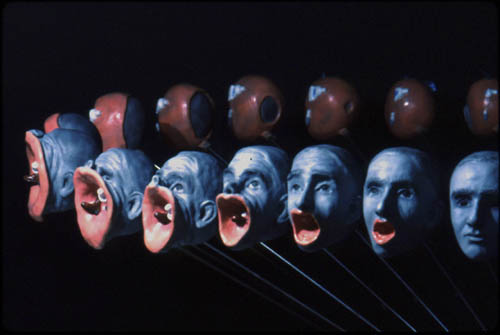
i love sculpture that moves. coming from an animation backround, i love the the idea that a sculpture could be an animate object, especially when that process of animation utilizes the same "persistence of vision" techniques required for cinema and traditional animation to occur.
gregory barsamian is an artist who builds large structures that contain short cyclical animated scenes, in which every frame of the scene is duplicated as a part of the sculpture. then the entire thing is set into motion and sync'd to a strobe light, so it appears that the animation is actually happening in one position over time. unfortunately, the video documentation available on the web is fairly poor and doesn't give a good sense of how amazing this work is, but seeing it in person is mind blowing.


gregory barsamian is an artist who builds large structures that contain short cyclical animated scenes, in which every frame of the scene is duplicated as a part of the sculpture. then the entire thing is set into motion and sync'd to a strobe light, so it appears that the animation is actually happening in one position over time. unfortunately, the video documentation available on the web is fairly poor and doesn't give a good sense of how amazing this work is, but seeing it in person is mind blowing.


Labels: mechanisms + things that move
Tuesday, March 06, 2007
The Subconscious Science of Design
simply put, what needs to happen with green energy, with clean energy, is that we need to make it hip. this is possible. let me make the comparison to the current boom in organic foods trend. people need to be aware of the absolute necessity of cleaner energies, and subsequently, how to get their hands on it, even though its invisible. for all the people out there buying cage free organically fed chicken eggs, these folks need to have access to more wholesome alternatives for energy. i'm talking target market people. who needs to make this happen? DUH. stop waiting around for the federal government to take the leap, because its clear they're not taking big steps. fact of the matter is, society as a whole is procrastinating! we need MORE word of mouth / blogger powered / gadget powered / take no prisoners style advertising to generate interest. we need every project we do to utilize sustainability, and we need our design and our product designs to reflect the elegance and importance of sustainability. we need corporate tech giants like IBMto step up to the plate and start taking care of the back end! and we need other companies with new found reputations of "hipness" like Apple to start backing us up! we need data visualization - a way to visually embody the problem, and offer SOLUTIONS! POSITIVE SOLUTIONS THAT ARE ABSOLUTELY FABULOUS!
in reverse news:
"The only thing we have to fear, is fear itself!"
frankly, i think a more relavant way to say it is:
"Its not that bright, that our strength is really fright."
so what good does spreading doom & gloom do us? I have no idea, but frankly i find fear based distribution of information regarding this particular topic rather paralyzing, and frankly paralysis and action are each other's antitheses. that being said let me reiterate:
"a way to visually embody the problem, and offer SOLUTIONS! POSITIVE SOLUTIONS THAT ARE ABSOLUTELY FABULOUS!"
in reverse news:
"The only thing we have to fear, is fear itself!"
frankly, i think a more relavant way to say it is:
"Its not that bright, that our strength is really fright."
so what good does spreading doom & gloom do us? I have no idea, but frankly i find fear based distribution of information regarding this particular topic rather paralyzing, and frankly paralysis and action are each other's antitheses. that being said let me reiterate:
"a way to visually embody the problem, and offer SOLUTIONS! POSITIVE SOLUTIONS THAT ARE ABSOLUTELY FABULOUS!"
Monday, March 05, 2007
SOLAR XYLOPHONE -> LEGO DRAGON
Fellow ITPer Rory Nugent and I had the idea to create a solar powered xylophone in an effort to explore and learn about possible uses for solar energy. The idea starts with harvesting from an array of solar cells to turn a small motor that will subsequently turn several axled gears - each equipped with small spinning hammers that would each play a note on a xylophone. The really enjoyable part of this idea is that if each gear is a different size, it will spin at a different rate meaning the hammers would hit each note at a different time, so the pattern that emerged would take a long time to unfold, sequential, but not obviously repetitive.

We momentarily abandoned the idea of the xylophone in exchange for a toy piano, with the hope of using a Lego motor and some linkages instead of gears. After realizing that the two solar cells we could get to work in accordance with one another were enough to power a motor, but not enough for the motor to carry an additional load, we gave up on music altogether and decided to make a wiggling Lego dragon.
we are using a slightly modified version of
this circuit from solarbotics:

(a link to the full document below)
while at first we spent a lot of time trying to set the voltage trigger to several different configurations, in the end we settled for what was shown on the site. in place of R4 we are using just a wire and for the rest of the resistors staying with the 100kOhm baseline
things that have raised the biggest questions thus far:
1.) Parallel Vs. Series
that when the solar cells were in parallel, the amperage increased & voltage stayed the same (to be expected), but when placed in series, the voltage increased but the amperage seemed to drop(!?)
2.) Varying Cells
when different types/sizes of cells were combined (in parallel or series) the circuit wouldn't work.
-is this a "phasing" issue?
3.) Voltage Trigger/Moniter
the diagram shown in the solarbotics PDF on how to use the Maxim 8212 voltage regulator in a circuit did not seem to be very accurate in terms of what level of resistance to use to achieve the desired voltage trigger.
4.) Capacitance
if we add capacitance, the time it takes to reach the trigger is longer, and vice versa but what is the relationship between the capacitance and the resistance?
We momentarily abandoned the idea of the xylophone in exchange for a toy piano, with the hope of using a Lego motor and some linkages instead of gears. After realizing that the two solar cells we could get to work in accordance with one another were enough to power a motor, but not enough for the motor to carry an additional load, we gave up on music altogether and decided to make a wiggling Lego dragon.
we are using a slightly modified version of
this circuit from solarbotics:

(a link to the full document below)
while at first we spent a lot of time trying to set the voltage trigger to several different configurations, in the end we settled for what was shown on the site. in place of R4 we are using just a wire and for the rest of the resistors staying with the 100kOhm baseline
things that have raised the biggest questions thus far:
1.) Parallel Vs. Series
that when the solar cells were in parallel, the amperage increased & voltage stayed the same (to be expected), but when placed in series, the voltage increased but the amperage seemed to drop(!?)
2.) Varying Cells
when different types/sizes of cells were combined (in parallel or series) the circuit wouldn't work.
-is this a "phasing" issue?
3.) Voltage Trigger/Moniter
the diagram shown in the solarbotics PDF on how to use the Maxim 8212 voltage regulator in a circuit did not seem to be very accurate in terms of what level of resistance to use to achieve the desired voltage trigger.
4.) Capacitance
if we add capacitance, the time it takes to reach the trigger is longer, and vice versa but what is the relationship between the capacitance and the resistance?
Labels: Sustainable Energy